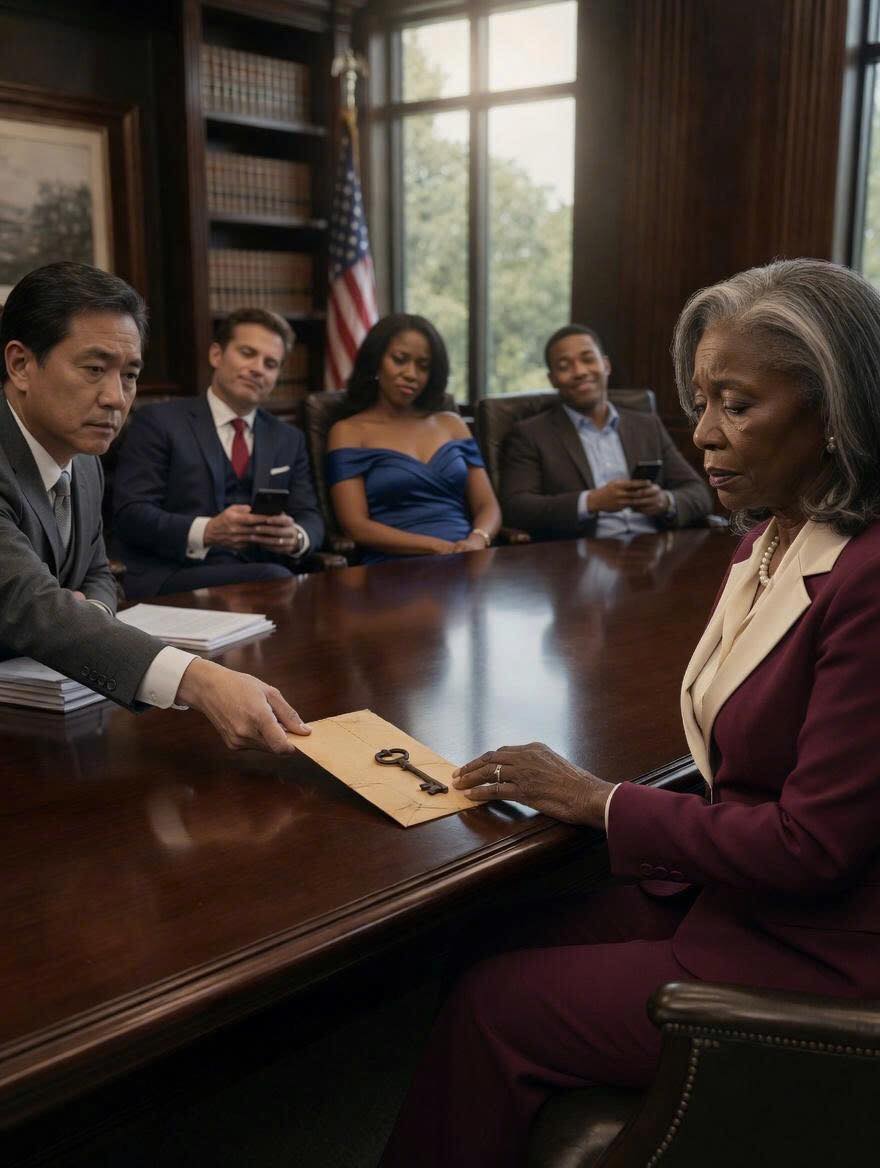
At my husband’s will reading, his three grown kids smirked as the lawyer gave them the mansion, the accounts, everything—and handed me, his wife of 40 years, only a rusty iron key and a scrawled address to a “worthless” house in a town nobody had heard of. They gave me 30 days to disappear, so I left with one suitcase and my wedding photo… and drove into the woods expecting a collapsing shack. But when that key turned in the oak door, I stepped into a house lined with hundreds of secret photos of me… and on the desk sat a sealed envelope in his handwriting that made my knees go weak: “for Peggy.”
The attorney’s voice was polished enough to make cruelty sound civilized.
It slid through the conference room with the smooth, expensive calm of a man who had spent twenty years delivering bad news in measured doses, never too fast, never too softly, never allowing the ugliness of a sentence to stain the mahogany table beneath it. Marcus Chen did not swallow words. He arranged them. That morning, every syllable seemed carved rather than spoken, and Peggy Anne Morrison sat across from him feeling each one land like a small, precise cut.
She sat very straight in the leather chair because she had been trained, by life first and by Richard Morrison second, to sit straight when something hurt.
Hands folded lightly in her lap. Chin level. Shoulders down. Breath even. Never fidget. Never interrupt. Never let people see you scrambling internally, no matter how badly the ground was shifting underneath you.
Forty years earlier, when she was twenty-eight and still Peggy Whitaker and newly hired as a legal secretary at Morrison & Vale, she had learned those rules within days. The men in that office rewarded calm. They mistook restraint for elegance, silence for competence, and invisibility for loyalty. Peggy had been good at all three before she even knew those qualities would become her currency.
Now, at sixty-eight, those same rules were the only reason she did not shatter outright in the room where her husband’s will was being read.
Across the long conference table, Richard’s children looked like they had dressed for a closing rather than a death. Steven sat nearest the attorney, broad-shouldered and rigid, his posture carrying the brittle self-importance of a man who believed inheritance was a confirmation of character rather than an accident of birth. His cufflinks flashed silver each time he adjusted his wrist. Catherine sat beside him in a cream silk blouse and a dark tailored skirt, her blond hair sleek, her lipstick untroubled, her expression composed in that perfected way women learn when they have decided softness is a weakness to be bred out of them. Michael, youngest and least disciplined, slouched with one knee bouncing beneath the table, his phone face down but close enough to touch, like an addict pretending to be uninterested in a bottle.
None of them looked grief-stricken.
They looked impatient.
Marcus cleared his throat and turned a page.
“The primary residence in Brookline,” he said, eyes lowered to the document in his hands, “including all fixtures and appurtenances, is left in its entirety to my children from my first marriage—Steven Morrison, Catherine Morrison Grant, and Michael Morrison—share and share alike.”
Peggy’s hands tightened, then loosened. She had known the Brookline house would most likely go to them. She had never been fool enough to imagine Richard would hand her sole ownership of the mansion he had bought with his first wife, the house where his children had grown up, the house that sat under the Morrison name like a family crest carved into stone.
Still, she had expected something.
A life estate, perhaps. The right to remain in residence until her death. A trust ensuring housing and expenses. A clause recognizing forty years of marriage as something more than an extended domestic arrangement.
She had expected acknowledgment.
Marcus continued.
“The bank accounts, the investment portfolios, the retirement holdings, and all liquid assets are to be divided equally among my children, Steven, Catherine, and Michael.”
There was the faintest shift across the table. Steven’s shoulders lowered half an inch. Catherine’s mouth softened at the corners, not into a smile exactly, but into the relief of confirmation. Michael’s knee stopped bouncing.
Peggy stared at Marcus as if there might still be a turn coming. Surely now, she thought. Surely now the language would change. Surely after house and money and securities there would be some provision for the woman who had spent four decades beside Richard, waking in his bed, tending his routines, receiving his guests, smoothing his collars, attending his dinners, remembering his medication, planning his travel, pouring his coffee precisely at seven each morning, listening to him breathe at night in the dark while the rest of the world slept.
Now, she thought. Now my name.
Marcus turned another page.
When he looked up this time, his face had changed. Not dramatically. If you didn’t know him, you might not have noticed anything. But Peggy had known Marcus for years in the curated, hospitable way wives know their husbands’ professional associates. He had eaten at her table, complimented her roast chicken, stood with a drink in his hand in the Brookline living room during holiday receptions and thanked her for always making the house feel warm. He was a careful man. He kept his expression under control the way surgeons keep their hands steady.
Now, for a single exposed second, Peggy saw something raw flicker there.
Pity.
“Peggy,” Marcus said quietly, and the sound of her name in that room was so heavy it felt like something tolling in a church.
She lifted her eyes fully to his.
“I’m… very sorry.”
The words were not part of the will. They were his own, inserted like a hand reaching for a railing too late.
Peggy opened her mouth, but the muscles in her throat seemed to have forgotten what speech was.
Marcus lowered his gaze again. “I am required to read this verbatim.”
Then he did.
“My wife, Peggy Anne Morrison, has lived comfortably at my expense for forty years and has wanted for nothing during the course of our marriage. She has had the benefit of my wealth, my home, my social standing, and a lifestyle far beyond what she could have achieved on her own.”
The room went thin around the edges.
For one impossible second Peggy thought she might be having some sort of physical episode. Her hearing changed first, a pressure in the ears like being underwater. Then the visual field narrowed. The conference room remained visible—the expensive grain of the table, the dark brass light fixture above it, the framed art on the walls chosen by somebody whose goal had been discreet power—but it felt very far away, as though she were staring at it from the wrong end of a tunnel.
At my expense.
Wanted for nothing.
Could have achieved on her own.
She had spent four decades knowing Richard could be emotionally cold, knowing he compartmentalized, knowing he measured affection in provision and preference rather than in speech. But this language was not merely distant. It was degrading.
Companionship. Domestic services. Compensation.
Those words had not yet come, but she could already feel them approaching through the fog like shapes moving in bad weather.
Marcus’s voice continued, carefully steady, the voice of a man doing his job while hating its contents.
“In exchange for the companionship and domestic order she has provided over the course of our marriage, and in acknowledgment of the many years she has served my household with loyalty—”
Served.
Peggy’s stomach lurched so hard she had to press her knee into the underside of the table to stay anchored.
Served.
Not shared. Not built. Not lived. Served.
Like hired help.
Like a caretaker.
Like a woman whose forty years in a marriage could be reduced to a list of functions performed successfully.
The room did not gasp. No one across the table protested. Richard’s children merely sat there receiving the words with a stillness so complete it became its own answer. This did not shock them. Or if it did, it pleased them enough to hide it.
Marcus turned another page.
“Therefore, I leave to Peggy Anne Morrison only the following: one property I own located at 47 Oakwood Lane in the town of Milbrook, Massachusetts, along with all contents contained therein. This property is given to Peggy with the express understanding that she will vacate the Brookline residence within thirty days of my death.”
Only.
The word snagged in her mind like a thorn in silk.
Only.
Forty years collapsed into a single dismissive adverb.
Peggy heard herself speak before she felt the breath needed to form the words.
“What about me?”
It came out soft. Not dramatic. Not accusatory. Just bewildered. The kind of question a person asks when she has stepped into a room she thought she knew and discovered all the walls are fake.
Marcus looked up. The lawyer’s composure held, but his eyes gave him away.
“Peggy—”
Steven moved before Marcus could say anything else, shifting back in his chair with the faint smug restlessness of a man whose desired outcome was settling cleanly into place. Catherine lowered her gaze, but not before Peggy caught the small gleam there, the one she had seen on Catherine’s face decades earlier when she was eighteen and had leaned close at Peggy’s wedding reception to say, with a smile sharp as cut glass, You’ll never be our mother. Don’t even try.
Michael finally picked up his phone and glanced down at it while the reading continued, as if the remainder of the document were logistics.
Peggy stared at Marcus.
He swallowed and returned to the paper. “There are no additional provisions for you in the will beyond the transfer of the Milbrook property and its contents.”
No additional provisions.
Not a wife. A line item.
Marcus reached into a brown envelope on the table and withdrew a large rusted key. He placed it back inside, slid the envelope toward her, and this time he did not attempt neutrality.
He pushed it with both hands, almost reverently, the way a priest might handle relics or a doctor might present the belongings of the dead.
The envelope stopped inches from Peggy’s folded hands.
Steven stood first.
“We’ll need to move quickly on the Brookline house,” he said, his voice brisk now, already leaving grief behind for process. “The market is strong. We’ve contacted a stager, and Catherine knows a realtor who specializes in historic properties.”
Catherine turned her head toward Peggy with a look she almost managed to soften.
“At least you have somewhere to go,” she said. “Daddy did leave you something.”
Michael typed a message without lifting his eyes. “Thirty days is plenty.”
Peggy placed one hand on the brown envelope and felt its weight. Heavier than it looked. Not with money. Not with mercy. With irony. With insult. With whatever remained when a woman’s life had been appraised and discounted.
She stood.
Her body obeyed. Strange, how betrayal did not necessarily stop the mechanics of movement.
Marcus rose halfway, as if he might come around the table and help her, then stopped, perhaps understanding that pity offered publicly in front of the others would only deepen the humiliation.
“Peggy,” he said. “Please call me if—if you need anything at all.”
She nodded once without turning.
The hallway outside the conference room was lined with framed black-and-white photographs of Boston courthouse facades and old judicial portraits. She walked past all of them with measured steps, carrying the envelope like evidence. The receptionist at the front desk looked up and opened her mouth as if to offer condolences, then seemed to think better of it. The elevator came too slowly. The parking garage smelled like old concrete, oil, and damp winter air.
She found her ten-year-old Honda Civic on the third level, unlocked it, got inside, closed the door, and sat with both hands on the steering wheel.
Nothing happened for nearly a full minute.
Then everything did.
The tears arrived so suddenly they felt violent. Not delicate tears. Not elegant widow’s tears. Not even the exhausted crying she had done in private after difficult holidays or one of Catherine’s little public slights or one of Steven’s cold dismissals or the nights when Richard was away at “the property” and the house seemed to exhale its emptiness around her.
This was animal grief. Humiliation bursting through shock.
Her breath broke. Her shoulders folded. A sound came out of her that she had not made since childhood, some wounded keening cry she would have been mortified to hear in any other circumstance. She pressed one hand to her mouth and wept until her lungs hurt, until the garage blurred beyond the windshield, until her skin felt hot and her fingers numb.
Because it was not merely that Richard had left her little.
It was that he had described her as little.
He had translated forty years of marriage into service rendered, comforts received, status borrowed, gratitude owed. He had written her out of the story of her own life and reduced her to a beneficiary of his generosity.
When the sobbing finally loosened into shudders, she reached for a packet of tissues in the glove compartment and wiped her face. Her mascara had smudged beneath her eyes. Her nose was pink. The woman in the rearview mirror looked not elegant or tragic but wrecked.
She stared at herself a long moment and then, because the envelope was there and because anything was better than sitting with the acid of that will still burning in her chest, she opened it.
Inside lay the iron key, rusted and heavy, old enough to belong to another century.
Beneath it was a folded page of cream stationery.
Peggy recognized Richard’s handwriting before she opened it. No one wrote like Richard. Precise, measured, disciplined. Each letter slanted slightly rightward, never rushed, each line evenly spaced. Even his handwriting conveyed control.
Her fingers trembled as she unfolded it.
Peggy, this is yours now. Go there as soon as you can. You’ll understand everything once you arrive. I’m sorry I couldn’t tell you before, but they were always watching, always listening, always looking for ways to challenge anything I tried to do. Trust me one last time, my darling.
All my love always,
Richard
She read it once. Then again. Then a third time, because the meaning would not settle into a shape her heart could accept.
Trust me one last time.
After what he had just done to her, the request felt obscene.
And yet the letter existed.
They were always watching.
They were always listening.
Anything I tried to do.
Richard was a man who lived inside strategy. He had spent a lifetime anticipating moves before other people knew there was a game on the board. If he had wanted to leave her nothing, he could have done so without theatrical cruelty. He did not need the language about expense and service and status. He did not need to humiliate her in front of his children.
Unless the humiliation was part of the strategy.
The thought was almost unbearable, because it required hope, and hope after public degradation feels like touching a live wire.
She folded the note carefully and placed it back in the envelope. For a long time she sat in the car listening to the fluorescent buzz in the garage and the distant echo of another vehicle starting somewhere beyond the concrete columns.
Then she started the engine.
The irony of that was not lost on her. Richard’s children had inherited everything that looked like wealth, and she drove away alone in the ten-year-old Honda she had always quietly maintained herself, the one no one thought valuable enough to mention.
By the time she reached Brookline, the sky had shifted to the cold silver of a Massachusetts afternoon in March. The house sat where it always sat, grand and symmetrical and self-important at the top of its slight rise, the white columns and brick façade as immaculate as if death itself had needed permission to enter.
For forty years Peggy had driven up that curving lane and told herself she lived there.
Now the house looked like a building in which she had been temporarily employed.
She let herself in with her own key and stepped into the marble foyer where the grandfather clock ticked with a sound suddenly unbearable in its indifference. The house smelled faintly of polish and lilies left over from funeral arrangements and the lemon oil she had used on the banister three days earlier. Nothing in the air said widow. Nothing said cast out. The house expected dinner at seven and fresh flowers in the drawing room and a discreet black dress hanging ready for the next formal obligation.
Peggy stood in the foyer holding the envelope and thought, absurdly, of the first day she had entered the house as Richard’s new wife.
She had been thirty then, wearing a pale blue suit she could barely afford and a hat Richard’s first wife would probably have considered provincial. The movers had not yet brought all her boxes. The staff—what little staff Richard still kept in those years—had hovered with curious restraint. Steven had looked at her as if she were a stain on a family portrait. Catherine had given her the same appraising glance she might have given an unwanted houseguest. Michael, sixteen and unformed, had slouched by the staircase and refused to say hello.
Richard had stood beside Peggy, hand light at the small of her back, and said, “You’ll settle in beautifully, darling.”
What he had not said was You will never truly belong here. Not to them. Not to this name. Not in the way you think marriage secures belonging.
Forty years later she carried two truths at once through the foyer of that house: Richard had loved her enough to send a private note from beyond the grave, and he had also failed to protect her in the open. Both were true. Love and cowardice. Devotion and concealment. Generosity and humiliation. The contradictions of a complicated man did not cancel each other out. They stacked.
That night she slept almost not at all.
She lay in the master bedroom beside the vacancy Richard’s body had left in the world and stared into the dark while the letter on the nightstand seemed to glow through the envelope like an accusation.
Trust me.
Around midnight she rose, wrapped herself in a robe, and walked barefoot through the silent house. In the kitchen she made tea she did not want. In the sunroom she stood looking out over the winter garden—bare rose canes, dark earth, stone paths slick from old rain—and remembered being thirty-one and kneeling in that soil with a trowel, planting peonies by hand because the gardener Richard occasionally hired did not understand that flowers were not decoration to her. They were the only part of the house she ever allowed to become wholly hers.
At two in the morning she sat at the dining room table and found herself remembering 1984 in vivid, painful fragments.
It had been a year made of sharp shoulders, big hair, new music on the radio, and a kind of cultural optimism she had never fully trusted but liked anyway. Peggy was twenty-eight, working in a smaller law office in Worcester, when she saw the advertisement for a legal secretary position at Morrison & Vale in Boston. Senior partner. Litigation. High pressure. Excellent typing and organizational skills required. Discretion essential.
Discretion. She could have built a life around that word even then.
Her mother had cried when Peggy moved into a tiny one-bedroom apartment outside the city. “You always want so little,” her mother had said while helping unpack dishes. “Ask for more at least once in your life.”
Peggy had laughed and kissed her cheek and said, “Maybe this is more.”
What she had meant, though she could not articulate it yet, was that security looked like more to a woman raised on scarcity.
The first time she met Richard Morrison he had been standing in the doorway of his office, one hand in his pocket, reading her resume while she stood opposite him trying not to sweat through her blouse.
He was handsome in the authoritative way of men accustomed to deference. Tall. Thick dark hair already silvering at the temples. Eyes so sharply attentive they made you feel inventoried within seconds. His office smelled of leather, paper, and expensive coffee. His suit fit perfectly. So did the room.
“You worked three years for Hollis and Frank,” he said, glancing down at the page. “Why leave?”
Peggy clasped her hands behind her back so he wouldn’t see them shake. “I’d like more responsibility.”
His gaze lifted to hers. “Most applicants say more opportunity.”
“I meant what I said.”
He looked at her for one long measuring second, and something about the corner of his mouth changed.
“All right, Ms. Whitaker,” he said. “Let’s see what you can do.”
She could do almost everything.
She reorganized his filing system in a week and found two missing case documents no one else had noticed were gone. She repaired the firm’s catastrophic calendar overlap by color-coding hearings, client meetings, and travel dates. She learned Richard’s rhythms so quickly that within a month she was placing calls before he asked, preparing folders before he remembered, ordering lunch for judges and visiting counsel without ever making the mistake of assuming a preference instead of quietly learning it.
She noticed he took coffee with two sugars and cream and that he disliked ringing phones during dictation. She noticed which clients required flattery, which required firmness, which needed to feel slightly afraid to pay their invoices on time. She noticed he loosened his tie with one hand when irritated and went absolutely still when truly angry.
She noticed, too, the first time he began noticing her.
Not her body first, though perhaps that too in some distant, cataloging masculine way. It was her competence he noticed. The efficiency. The way his days became smoother when she touched them.
Men like Richard often fall in love through utility first and realization later.
One evening six months into the job, long after the rest of the staff had gone, Peggy stepped into his office with a stack of corrected filings and found him leaning back in his chair, jacket off, tie loosened, one hand pressing lightly against his temple.
“Headache?” she asked.
