She laughed aloud when the name arrived, startling a bird from the hedge.
The next months filled with work so meaningful it erased whole categories of old despair.
She met with contractors about the cottage and barn. Converted the cottage into a cozy five-bedroom retreat space with a communal kitchen and private reading nooks. Turned the barn loft into a gathering room with long tables, soft chairs, and large windows facing the trees. Installed accessible bathrooms, new heating, better insulation. She spent the trust carefully but without the old terror that every choice required defense.
Marcus helped her establish the nonprofit arm.
“You know,” he said one afternoon while reviewing incorporation documents at her kitchen table, “Richard would be astonished you’re doing this.”
Peggy signed a paper and smiled faintly. “Then it’s probably good for me.”
He studied her over the rims of his glasses. “You’ve changed.”
She capped the pen. “I’ve appeared.”
Dorothy nearly spilled her tea laughing.
Word spread through Milbrook first, then farther. A social worker in Worcester heard about the retreat and asked whether a recently widowed client might come for a week. Then a woman from Concord called about her sister, divorced after thirty-two years, who “doesn’t know where to start because she’s forgotten how to choose a color of paint without asking permission.” A retired teacher from Providence arrived for a weekend and stayed a month. A former nurse came after her husband died and spent her days in the herb garden until she could speak about him without folding in half.
Peggy did not become a guru. She had no interest in turning suffering into brand identity. She simply offered what she had once needed: a place where women could be regarded as full people at the precise moment their old roles had collapsed.
She made good soup. She kept fresh flowers in every room. She learned who needed conversation and who needed silence. She created a small library of books on grief, finances, late-life reinvention, gardening, memoir, poetry, practical legal matters. She invited a retired accountant from town to teach monthly sessions on reading bank statements and understanding retirement accounts. She hosted evenings by the fire where women told the truth without dressing it in gratitude first.
Some nights, after the guests had gone to bed and the sanctuary had settled into its old breathing quiet, Peggy would sit alone on the porch and think about Richard.
Not with the rawness of the first months. More with a long, complicated tenderness.
He had loved her. That was undeniable now. The photographs alone proved an attention so sustained it would have been easier to dismiss had it not been so detailed. The legal work, the house, the funds, the planning, the ferocious strategic care of his posthumous protections—all of it was love translated into the language he trusted most.
And yet.
He had not stood beside her in the dining room when Catherine sneered. He had not said, This is my wife and you will treat her with respect. He had not put her name openly on Brookline. He had not taught his children to see her as anything but an interloper with polished manners. He had not given her the daily dignity that would have mattered more, in some ways, than the hidden fortune.
The sanctuary did not erase that.
Love concealed is not the same as love defended.
Still, Peggy no longer needed Richard to have been perfect in order to make use of what he had given. That, too, was freedom. To stop requiring the past to become cleaner than it was before allowing herself a future.
In October, almost exactly seven months after the will reading, Steven called.
She nearly let it ring out. But something in her—curiosity, perhaps, or a sense that unfinished stories sometimes deserve one controlled look before being shelved—made her answer.
“Peggy.”
He sounded tired. Not softened exactly. Tired.
“Yes?”
A long pause. Then, awkwardly, “I hear you’ve opened some sort of women’s retreat.”
“Word travels.”
“Yes.” Another pause. “Brookline finally sold.”
Peggy leaned back in the porch chair and watched leaves move in the wind. “I imagine that was complicated.”
He gave a short humorless laugh. “That’s one word for it.” Silence again. Then, more tightly: “Father’s trust structures were… unpleasant.”
Peggy said nothing.
Steven cleared his throat. “I called because—” He stopped. Started again. “I called because I wanted to say I misjudged things.”
Misjudged things.
Not you. Not us. Not what we did. Things. Abstract, bloodless things.
Peggy closed her eyes briefly. Even now he could not quite cross the distance into actual accountability.
“I see,” she said.
“I’m not asking for anything,” he said quickly. “Catherine suggested we stay away, and she’s probably right. Michael won’t say it, but he knows Father outmaneuvered us.” His voice dropped, some old anger still there under the fatigue. “I don’t know what he told you, but he made fools of all of us.”
Peggy opened her eyes again. The oaks were turning gold. “No,” she said quietly. “He revealed you.”
Silence. This one longer.
Then Steven said, almost unwillingly, “He really did love you, didn’t he.”
It was not a question any more than Dorothy’s had been at the front gate. It was a sentence Steven needed spoken back to him so he could hear its final shape.
“Yes,” Peggy said. “He did.”
When the call ended, she sat a long time without moving. Not triumphant. Not wounded. Simply clear.
That was all she had needed, perhaps. Not apology from Steven—he was too much his father’s son in the worst ways—but the end of denial. The end of the story in which she had merely hovered at the edges of Richard’s real life. She had been the center of an invisible life no one else was willing to see. Now they did.
That winter, during the first heavy snow, Peggy found herself back in the study sorting another shelf of Richard’s files when one slim notebook fell open in her hands. It was not legal material. It was a journal of sorts, though Richard would have hated the word. He had dated entries only sporadically over the years, most no more than a paragraph or two.
One, from 1987, read: Peggy planted white roses today. She knelt in the mud as if the world were simple. I have not seen anything holy in years except the back of her neck when she laughs.
Another, from 1999: Catherine was cruel to her at dinner. Peggy smiled and kept serving. I wanted to stop it and did not. Cowardice has many polished names.
From 2008: Brookline exhausts me. Oakwood restores me because it contains what is true. Peggy asleep by the fire with a book on her chest. If I had chosen differently when young, I might have learned how to deserve peace instead of merely hide inside it.
And one from just two years before his death: If she reads this one day, I hope she understands the terrible irony that the more I loved her, the more fiercely I concealed what was hers. Men like me rot from strategy. We mistake protection for intimacy. I hope she builds something kinder from the ruins.
Peggy sat at the desk and cried again, but gently now.
Then she placed the notebook in a drawer labeled KEEP and went downstairs to join the women in the kitchen, where Mrs. Patterson was scolding Harold for peeling apples too thickly and two retreat guests were laughing over a loaf of bread that had not risen properly.
The house was alive.
Not preserved. Alive.
Later, after dinner, Peggy stood in the doorway of the gathering room and watched as six women sat in a loose circle, each at a different stage of becoming. One was seventy-two and newly widowed after a marriage that had swallowed her. One was fifty-nine and leaving a second husband who treated “provision” as a moral get-out-of-jail card. One was forty-eight and trying to understand how her life had narrowed into service without her noticing the door closing. They spoke hesitantly at first, then more freely.
At one point a woman named Elise said, “I don’t even know what kind of lamp I like. Isn’t that ridiculous?”
“No,” Peggy said from the doorway before she meant to. The women looked up. She smiled and came into the room. “It’s expensive, forgetting yourself. It takes time to remember.”
Elise laughed weakly. “How did you remember?”
Peggy thought of the will reading. The parking garage. The key. The photographs. The study. The first morning in the sanctuary. The garden. The first decision she made without imagining someone else objecting.
“Very slowly,” she said. “And then all at once.”
They laughed, and the room warmed further.
That spring, on the first anniversary of Richard’s death, Peggy drove to the cemetery with a basket of white roses from the sanctuary garden. She had not been sure whether she would go. In the end, she did because avoiding him entirely had begun to feel like another form of unfinished dependence. She wanted to stand there not as abandoned widow or grateful beneficiary but as the woman she had become in the year since he died.
The grave was neat, understated, expensive in the tasteful way the wealthy prefer death to remain consistent with their branding. Richard Morrison. Beloved Father. Distinguished Attorney. Devoted Public Servant.
No mention of husband. That made Peggy laugh softly.
She laid the roses down and stood looking at the stone.
“You were impossible,” she told him. The breeze lifted the edge of her coat. “And brilliant. And weak. And sometimes tender enough to break my heart in retrospect.” She shook her head. “You would hate the curtains I put in the cottage. Too cheerful.”
The cemetery remained appropriately silent.
She looked down at the flowers. “I’m still angry with you,” she said. “I may always be. But I’m using what you gave me. And I think, somewhere beneath your appetite for strategy, that’s what you wanted.”
A crow called from a distant tree.
Peggy smiled faintly. “Also, your children hate me more efficiently now that they know I won.”
She had not expected laughter at a graveside, but it came. Warm, brief, shocking.
Then she stood a moment longer and said the thing she had once feared she would never say honestly again.
“I loved you too.”
Not because love excused what he had failed to do. Not because the dead deserve cleansing. Simply because truth had become easier to speak in all directions.
She walked back to the car feeling strangely light.
By summer, Oak Sanctuary had a waiting list.
A regional magazine ran a small feature on “a quiet woodland retreat founded by a former Boston society wife who reinvented grief as refuge.” Peggy disliked the article’s tone but appreciated the donations it generated. Marcus joined the nonprofit board. Sarah handled the reading program. Dorothy, naturally, became unofficial queen of hospitality and terrorized delivery men who arrived late with produce.
One afternoon Peggy stood in the restored central garden while a group of guests clipped lavender into baskets. The fountain, repaired and running, cast light into the air. Bees moved lazily among the herbs. The stone paths no longer disappeared beneath neglect. Roses climbed where she had guided them. Women’s voices drifted through the open windows of the barn, where someone was teaching a workshop on wills and medical proxies to an attentive room.
It struck Peggy with sudden force then that the life in front of her would have been unrecognizable to the woman in the conference room a year earlier.
That woman had believed herself at the end of something. In truth she had been standing at a border.
Sixty-eight, she thought, kneeling to pinch back a stem. Sixty-eight and beginning.
The phrase gave her a thrill so bright it bordered on laughter.
That evening, after the guests had gone inside and the sunset turned the western edge of the sky a bruised, glorious pink, Peggy sat alone on the porch of the main house and let the day settle around her. Wind moved through the oaks with a sound like distant applause. The porch light glowed gold on the boards. Somewhere a night insect began its patient rhythm.
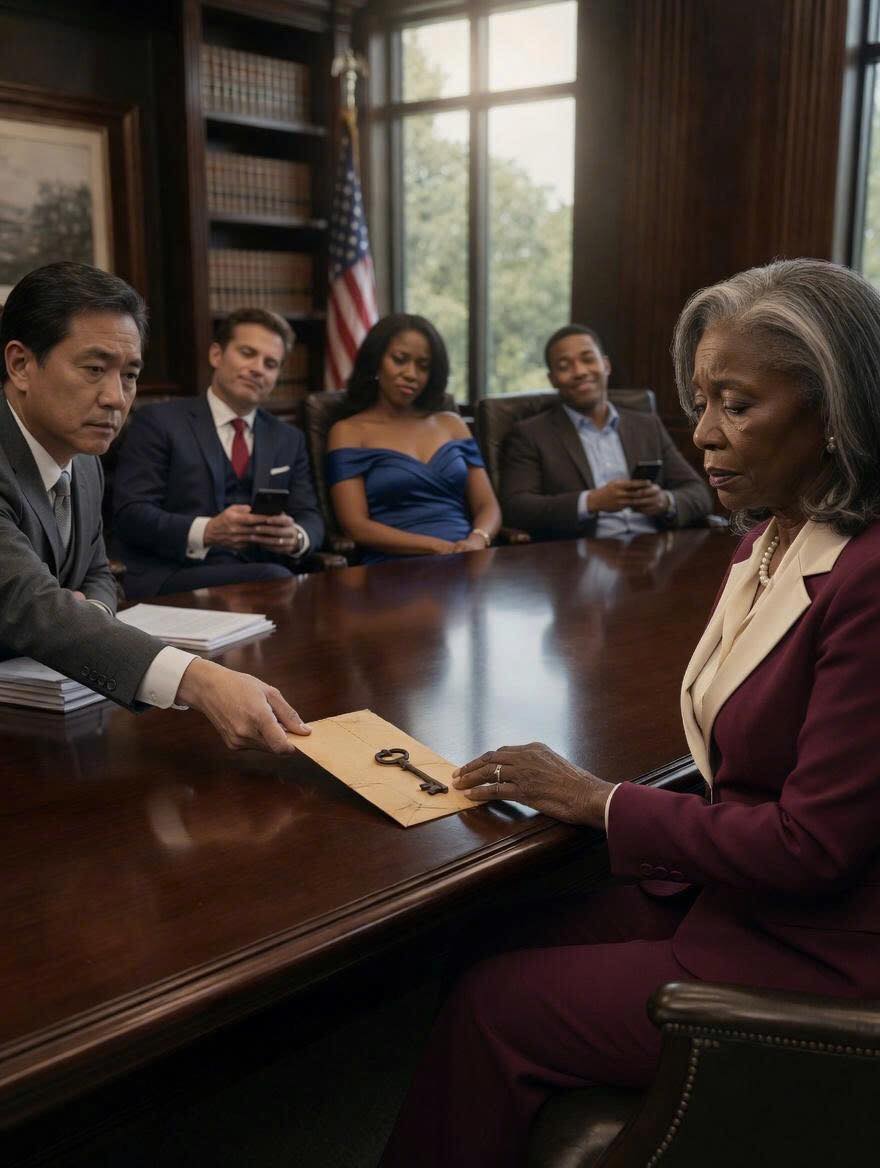
She thought about the will reading again, not with the same acid but with the clarity of distance. The attorney’s smooth voice. Steven’s cufflinks. Catherine’s smile. Michael’s phone. The line about expense. The line about service. The envelope across the table. The way humiliation had nearly convinced her the story was over.
How little they had understood.
Richard’s children had seen only visible wealth: the mansion, the accounts, the prestige. They could not imagine a man leaving his truest gift where vanity could not detect it. They saw money and assumed victory. They heard cruelty and assumed final truth. Their greed had narrowed their vision until they missed the entire landscape.
Peggy, too, had once mistaken visibility for reality. She had thought the Brookline house was the center because everyone treated it as such. She had thought public acknowledgement mattered most because public disregard hurt so badly. In some ways she was still right. Public dignity does matter. Love should not require secrecy to survive.
But there are other truths, she knew now. Hidden deeds. Quiet preparations. Forest roads that lead not to exile but to home. A life can appear erased in one room while being secured in another.
She leaned back in the porch chair and closed her eyes.
She was Peggy Anne Morrison, though sometimes lately she used Peggy Whitaker-Morrison on forms because reclaiming the maiden name alongside the married one pleased her. She was sixty-nine now. Widow. Gardener. Founder. Librarian’s assistant on Tuesdays. Terrible at delegating, improving slowly. Keeper of a sanctuary in the woods. A woman who had finally learned that silence is not the same as grace, and usefulness is not the same as love, and beginnings do not consult age before arriving.
For forty years she had been what others needed: efficient secretary, accommodating wife, polished hostess, invisible stepmother, domestic peacekeeper, soft edge around hard men. She had poured herself so consistently into other people’s shapes that by the time Richard died, she had almost forgotten she possessed one of her own.
Now she felt it clearly.
Not dramatic. Not loud. Solid.
A self.
The future no longer looked like a shrinking corridor. It looked like land. Paths. Rooms lit for people arriving wounded. Gardens needing seasonal attention. Legal binders on shelves. Women at tables learning where the money really is. The possibility of new friendships, new rituals, new work. Even joy, which had once seemed indecent after a certain age, now felt possible in modest, daily forms: bread rising well, a rose blooming twice, a guest laughing for the first time in weeks, a stack of library books on the nightstand, her own keys in her own hand.
She opened her eyes and looked out at the line of trees darkening against the sky.
For the first time in her life, there was no one she needed permission from.
Not Richard. Not Steven. Not Catherine. Not the old frightened girl who thought security meant accepting whatever terms were offered as long as they came wrapped in elegance.
At sixty-eight she had thought she was being discarded.
At sixty-nine she knew she had been released.
And beneath that knowledge, steady as roots under stone, lay the truest revelation of all:
She was not ending.
