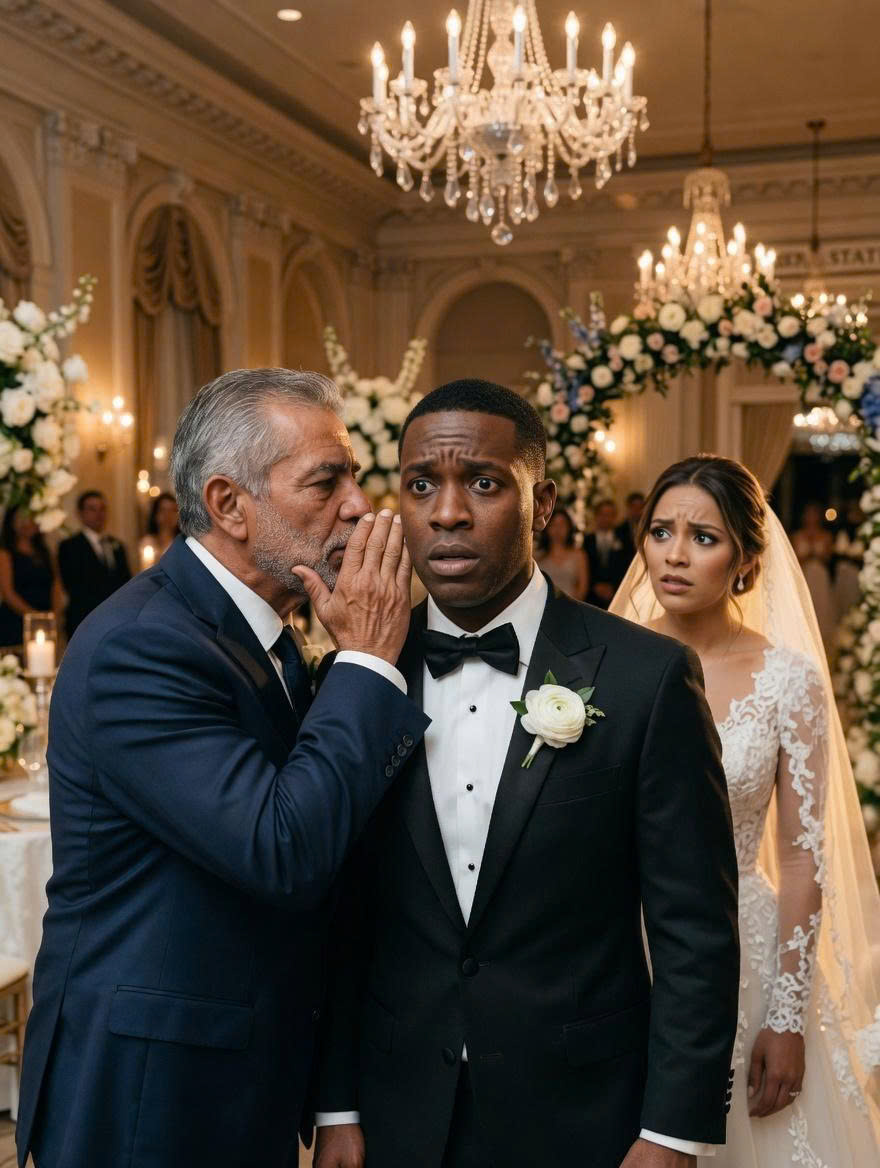
When he finished, he put the phone back exactly where it was and lay down next to the woman who had just become his wife. He didn’t cry. He didn’t scream. He didn’t wake her. He stared at the ceiling until dawn, while inside him another structure was being built: not a life with Adriana, but the exact way to escape that trap without destroying himself.
The honeymoon was in Los Cabos.
For four days, Julián played the role of the loving husband with surgical precision. He walked with Adriana on the beach, ordered her favorite wines, took her to dinner overlooking the sea, and listened to her plans about curtains, renovations, and family visits. While she smiled, believing she had already won, he observed, asked questions, and confirmed.
On the second night, over drinks, Adriana blurted out what he had been waiting for.
“My mom is going through a very difficult time,” he said, playing with the glass. “There are problems with the family home… and some debts. They’ll probably ask us for help. It would only be a temporary loan.”
—How much do you need? —Julian asked, as if it were nothing.
She paused briefly, deliberately.
—Maybe a million and a half pesos.
Julian took her hand and smiled.
—Of course we’re going to help your family.
The relief that crossed Adriana’s face was as quick as it was revealing.
That same morning, while she was sleeping, Julián called Daniela, his business partner and best friend of eight years, from the hotel gym.
“I need you to listen to me without interrupting,” he said.
And for twenty minutes he told her everything.
Daniela remained silent at the end.
“I knew something smelled fishy,” he admitted, “but I never imagined this.”
“I don’t need sympathy,” he replied. “I need proof.”
When they returned to Mexico City, the machinery began to move.
Daniela obtained information about Mauricio: two previous relationships with women who had married wealthy men and then ended in advantageous divorces. An old shared post office box. Suspicious transfers. A business entity created by Adriana and Mauricio eight months before that “casual” gala. An ex-girlfriend of Mauricio’s testified that Adriana had inquired about Julián long before meeting him: how much he earned, how many properties he owned, whether he had close family, whether he was distrustful.
Julian also visited a family lawyer, Patricia Ocampo, famous for being as elegant as she is ruthless.
“Don’t act out of anger,” she told him after listening to everything. “Act with precision. Anger leaves scars. Strategy brings freedom.”
In less than a week, they legally corrected the administrative error in the apartment’s deeds and returned it to Julián’s sole ownership. Then they drafted the loan agreement for Adriana’s family as a flawless document: dates, moderate interest rates, guarantees, and a clause for full acceleration in case of marital dissolution.
Just as Patricia had predicted, Adriana’s parents signed without reading.
Adriana too.
I believed that Julián was still the noble, generous, and absent-minded man they could calmly drain.
A month passed.
One Sunday night, in Julián’s kitchen, Adriana was serving baked salmon and talking about redecorating the living room. He looked at her with a tranquility that was no longer love, but rather a sense of conclusion.
When they finished dinner, he placed his phone on the table, screen facing up.
One of the messages between Adriana and Mauricio shone brightly on it.
The phrase “safe money” was underlined.
Adriana remained motionless.
For a few seconds he tried to act: he frowned, feigned confusion, looked up in indignation.
—Did you check my phone?
Julian opened his briefcase and began taking out documents one by one. The company’s articles of incorporation. His father’s bank transfers. Mauricio’s ex-girlfriend’s statement. Recent photographs of Adriana entering a restaurant with him. The loan agreement. The corrected deeds. The already signed divorce petition.
Adriana’s mask fell off like broken glass.
“You don’t understand,” she said at first, her eyes moist. “Things got complicated… I did come to feel something for you.”
Julian left a photo on the table where she appeared laughing with Mauricio, taken just two weeks earlier.
—It looks very complicated, yes.
Then she changed. She dried her tears and finally showed the real face he had never wanted to see.
—You’re going to regret this. I get half of everything.
“No,” he replied. “It’s your turn to leave.”
—The scriptures!
—Corrected.
-My family…!
—In sixty days they must return every penny of the loan or they will enter into legal collection.
Adriana looked at him with a mixture of fury and panic.
—Were you pretending all this time?
Julian stood up.
—No. I was paying attention the whole time.
She left the house three days later.
Weeks later, Julián went to see Adriana’s parents. Not for revenge. For closure.
Don Ernesto opened the door with the same defeated expression he’d worn on his wedding day. His mother, Rebeca, waited for him in the kitchen, her pride shattered. Julián placed a copy of the contract on the table and spoke without raising his voice.
—I know about the company. I know about the transfers. I know they chose me because they thought a man who built everything from the ground up would be too grateful to suspect anything.
Don Ernesto wept silently.
“I wanted to warn you,” he murmured.
“Too late,” Julian replied. “But I didn’t come for that. I came so you understand something: you weren’t trying to take my money. You were trying to make a mockery of everything it took me to get here. And that can’t be forgiven with a shaky apology in a hotel room.”
He left without waiting for an answer.
The following months were tough, but clean.
The divorce went in her favor. Mauricio ended up embroiled in a civil lawsuit for fraud when other women, seeing the pattern, decided to speak out. Adriana’s family had to sell the house. And Julián, for the first time in a long time, could breathe again without feeling like someone was watching him, calculating how much they could squeeze out of him.
He took refuge in his work.
He finished designing a community center in Iztapalapa and then led an affordable housing project on the city’s outskirts, where two hundred families would have a decent home. Every plan, every calculation, and every decision gave him back a part of himself. He started calling his mother every night again. He started sleeping soundly again. He started laughing again.
And, without realizing it, he also began to look at Daniela differently.
She had been there from the beginning: when he had nothing but ideas and cold coffee on his desk, when he doubted himself, when he refused to see the signs, when he had to quietly rebuild himself. She never said, “I warned you.” She never looked at him with pity. She was simply there.
One Friday, after an important presentation, they went out for tacos al pastor at a simple stand, far from elegant restaurants with perfect facades. Julián watched her laugh as she wiped salsa off her finger and felt something so serene that he was afraid to name it.
“What?” Daniela asked, smiling.
“Nothing,” he said. “I was just thinking that with you everything feels… real.”
She looked at him silently for a few seconds.
—Because it is.
It wasn’t a whirlwind romance or a scandalous affair. There were no fireworks or exaggerated promises. There was time, trust, and truth. And for Julián, who had mistaken intensity for love, that proved far more powerful.
Two years later, on the day of the inauguration of the housing complex he himself had designed, Julián stood under a clear sky, listening to children running through the gardens and excited mothers receiving their keys. Daniela was beside him, her hand intertwined with his. She wore a simple dress and a discreet ring that he had given her without haste, without pressure, and without fear.
“You did it,” she whispered to him.
Julian observed the warm facades, the large windows, the people entering their new homes. He smiled.
—No. We did it.
For a moment he remembered that morning at the ranch, twenty minutes before a wedding that almost cost him everything. He remembered the belated warning, the betrayal, the silent humiliation of knowing he had been chosen not for love, but for utility.
And she understood something you only learn after surviving a big lie: losing the wrong person isn’t a tragedy. It’s a liberation.
Julian never looked back.
