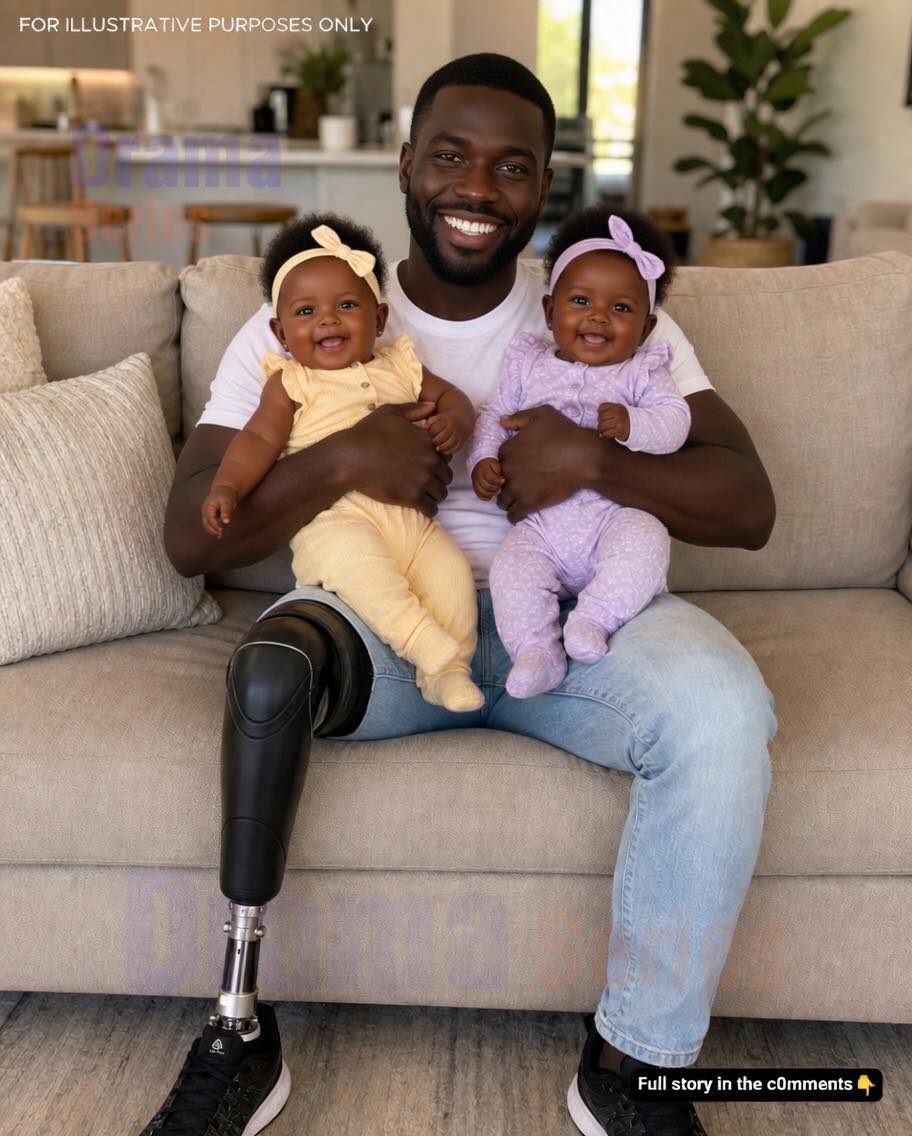
I don’t usually talk about this, but what happened still doesn’t feel real.
I’m thirty-five now, though some mornings I wake up feeling much older. Pain has a way of adding years to a man, not just in his bones, but in the quiet places of his heart.
Three years ago, I came home from service with a prosthetic leg and one thought that had kept me going through every difficult day: my wife, Mara, and our newborn twin girls.
Emma and Lily.
I had only seen them through photos and short video calls. Tiny faces wrapped in pink blankets. Little fists curled under their chins. Every night, when the pain got bad and the future felt uncertain, I stared at those pictures and told myself, Hold on. You have a family waiting.
I didn’t tell Mara I was coming home early. I wanted to surprise her.
I imagined the door opening. Her eyes filling with tears. Her arms around my neck. I imagined holding my daughters for the first time while she stood beside me, smiling.
For illustrative purposes only
But when the taxi stopped in front of our house, something felt wrong.
The curtains were gone.
The porch swing Mara had begged me to build was missing.
I stood there for a moment with my bag over one shoulder, leaning on my cane, telling myself not to panic.
Maybe she was redecorating.
Maybe she had taken the girls to her mother’s.
Maybe everything was fine.
Then I opened the front door.
The house was almost empty.
No couch. No dining table. No photos on the wall. No baby toys scattered on the floor.
Just bare rooms and a silence so heavy it felt like someone had died.
Then I heard crying upstairs.
Not one baby.
Two.
My heart slammed against my ribs.
I forced myself up the stairs, each step sharp and slow, my prosthetic leg still new and uncomfortable. By the time I reached the nursery, sweat ran down my back.
Emma and Lily were screaming in their cribs.
And my mother was there.
She sat between them in a rocking chair, pale and shaking, trying to hold one baby while reaching toward the other.
“Mom?” I said.
She looked up, and her face broke.
“Oh, Caleb…”
“Where’s Mara?”
She didn’t answer. She just kept whispering, “I’m so sorry. I’m so sorry.”
Then I saw the note on the dresser.
My hand shook as I picked it up.
I’m too young to waste my life on a broken man and changing diapers. Mark can give me more. As for the babies—keep them.
Mark.
My best friend.
The man who had stood beside me at my wedding. The man who had promised to check on Mara while I was away.
For a few seconds, I couldn’t breathe.
My mother told me later that Mara had left two days earlier. She had emptied the house, taken the savings, and disappeared with Mark. My mother had come by only because she had a bad feeling after Mara stopped answering calls.
If she hadn’t…
I still can’t finish that thought.
For illustrative purposes only
That night, I sat on the nursery floor with both daughters in my arms.
Emma finally stopped crying first. Lily followed, her tiny hand curled around my finger.
I looked at their faces and made a promise.
“You will never feel abandoned again,” I whispered. “Not while I’m alive.”
The next three years were the hardest of my life.
I learned how to change diapers while balancing on one leg. I learned how to warm bottles at three in the morning with my eyes half closed. I learned which cry meant hunger, which meant fear, and which meant “Daddy, I just need you.”
There were nights I cried in the laundry room where they couldn’t hear me.
There were days I almost gave up.
But I didn’t.
My mother helped when she could, but she was getting older. So I found work repairing small engines from my garage. Lawn mowers, motorcycles, old generators—anything people brought me.
At first, customers looked at my prosthetic leg, then at the twins playing nearby, and I could see the pity in their eyes.
I hated that look.
So I worked harder.
By the time Emma and Lily turned three, my garage had become a real business. Nothing fancy, but steady. Honest. Mine.
The girls grew into sunshine.
